On a cold morning in Scottsburg, Indiana, cars line up outside the Turning Point Church food pantry for distribution, their rising exhaust mixing with an unwelcome snow.
It’s weather that would keep anybody inside if they had the choice. Yet, a group of regular volunteers who showed up to hand out food at the pantry are stuffing hand warmers into knit gloves and winter caps, readying themselves to spend hours in freezing temperatures to feed the community.
That’s all happening after they’ve already spent three hours packing boxes with essential food items. If people facing hunger have to come out in this weather, they surmise, so will they.
“We’re a small community,” said Mare Burns, who leads the food pantry. “Everybody knows everybody. The people are just wonderful, and we all just love giving back.”

Volunteers distribute food in the snow at a mobile distribution in Scottsburg, Indiana.
What began as a small church pantry tucked into a closet has grown into a lifeline for hundreds of families across Scott County.
The pantry recently received a $5,000 grant from Gleaners to purchase a commercial cooler — an investment that expanded the type of fresh produce they can offer neighbors.
“That helped us out a whole lot,” Burns said. “Now, we can get all our fresh vegetables and stuff from Gleaners.”
The partnership with Gleaners also connected the church with additional food resources that became available during the COVID-19 pandemic. Volunteers refer to the large food packages distributed at the time as “COVID boxes,” and their introduction marked a turning point for how giveaways work.
“Once that happened, the pantry just grew,” Burns said. “I mean, sometimes in the summertime we’ll have 226 boxes.”
Demand fluctuates throughout the year. In the summer, when school is out and children no longer have access to school meals, the need often rises.
“In the summertime, we’ll give about 180 boxes away,” Burns said. “In the wintertime, like now, I think we’ve been running about 130, 140.”

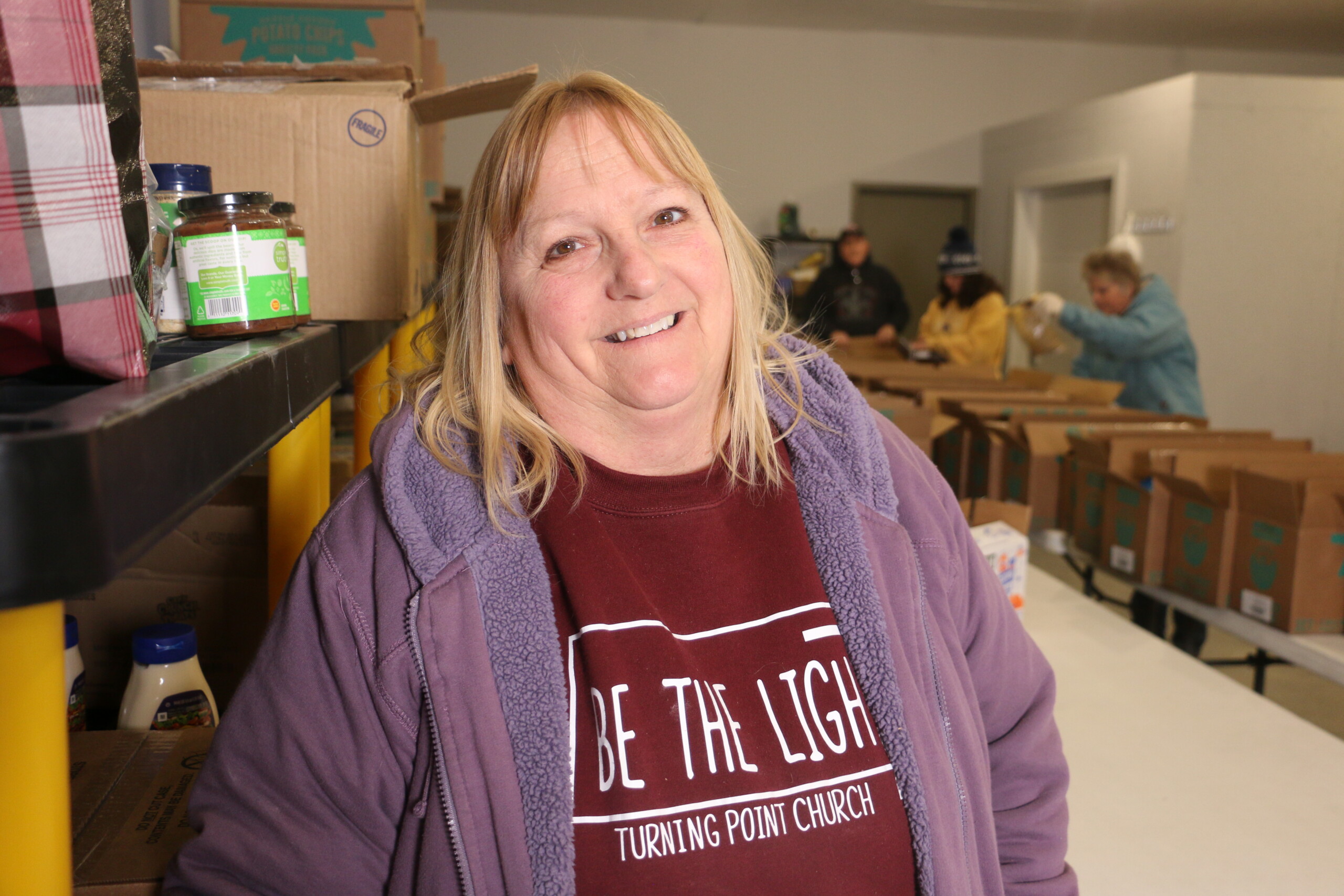
A regular group of volunteers with Turning Point Church spend hours prepping boxes ahead of distribution.
Curtis Richie, who has volunteered for about three years, helps direct traffic during distributions that keep mobile units running. Cars are staged in rows across the church parking lot, moving forward in waves as boxes are loaded.
“We try to park them when they come in. It’s kind of like first in, first out,” Richie said. “We line them up, and then we increase the lines. As one line moves out, the next line will start.”
The system allows families to remain in their vehicles, a convenience many appreciate.
“I think it’s very convenient,” said Loretta, a Scottsburg resident who frequently attends distributions. “They’re wonderful people.”
Loretta is retired and living on Social Security. She says the monthly groceries she receives from Turning Point ease difficult financial choices.
“This helps a lot with groceries,” she said. “I’m retired, and you know how Social Security goes. I don’t get much money on Social Security. And this really helps a lot.”
About 80% of those served at Turning Point are older, retired adults, according to pantry leaders. Many are living on fixed incomes and are stretched thin by rising costs of utilities, medication and housing. Volunteers are often told that, without the pantry, they would have to choose between food and prescriptions.

An estimated 15.2% of people living in Scott County, Indiana are food insecure, according to Map the Meal Gap data provided by Feeding America.
“The people are so grateful,” Burns said. “They will tell us, ‘Well, if it wasn’t for you, we wouldn’t be able to buy our medicine.'”
Hunger levels in Scott County are among the highest in Indiana.
An estimated 15.2% of people living in Scott County are food insecure, according to Feeding America research.
Given such great need, the church limits distributions to one box per person. That’s not because they want to, but because they will run out of food otherwise. The set number per vehicle ensures supplies last through the distribution. Even with those limits, volunteers remain flexible throughout the week. If someone calls to say they cannot arrive until later in the day, workers set aside a box.
At Turning Point, volunteers can and will go the extra mile for community members whose names and faces they know.
“If somebody calls us and says, ‘I can’t get there till 12 or 1,’ we’ll hold boxes back for them,” Burns said. “We’ll make sure they have food, so they don’t go hungry, especially if they’ve got kids.”
Throughout the week, the ministry continues beyond the scheduled distribution day. If a family is referred by a neighbor or church member, volunteers work fast to assemble emergency boxes to take home.
“We don’t only do this distribution,” Burns said. “During the week, if somebody needs food, or there’s a family that somebody knows that needs food, we’ll come in and we’ll build them boxes.”
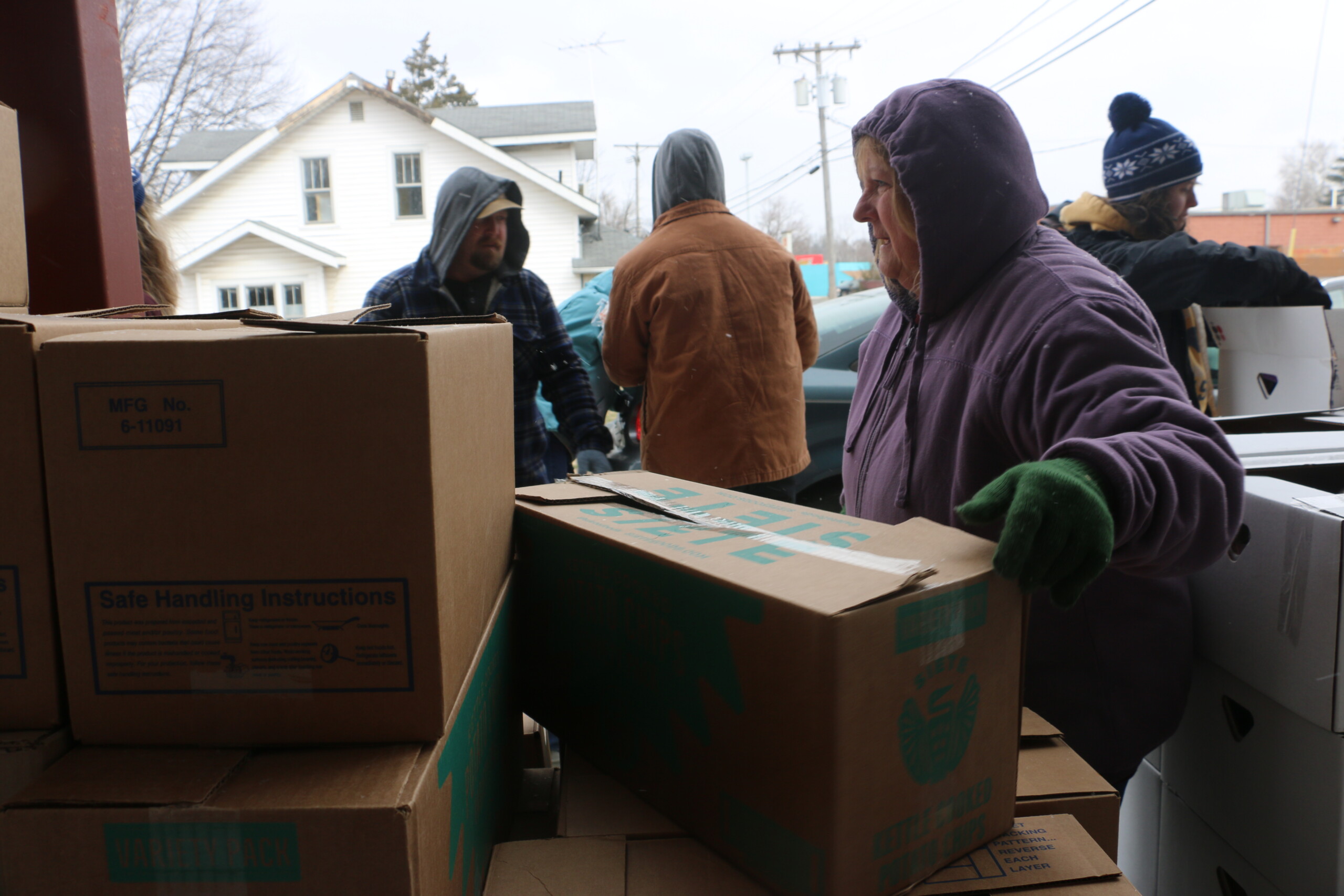
Pantry coordinator Mare Burns helps distribute boxes of food to the community.
The pantry began from humble roots and grew to try and meet increased community demand. In its earliest days, food was stored in a closet. Volunteers purchased groceries themselves, shopping discount stores and local meat lockers for protein. As need increased, the space felt smaller.
“The need got greater and greater, and the closet got smaller and smaller,” Burns said.
Today, the operation stretches across the church grounds and operates out of a small warehouse where volunteers laugh and find community in serving others, with many of them calling one another a second family. The work is as much about fellowship as it is food.
“It’s a joy to serve,” Burns said. “All of us feel that way. We just love what we’re doing.”
The pantry has shut down only twice in recent years. Once was due to severe weather and another time when the leader and her husband both underwent surgery within a week of each other.
Aside from that, Burns has not missed a distribution day in seven years.
“We hate to miss it,” Burns said. “We don’t want to miss anything at all.”
For Richie too, volunteering is an extension of his faith and a call to serve others.
“We try to be a blessing,” he said. “We go to church here. We’re retired, so we kind of have the time to do that. We’re just trying to be a blessing and help out to those that are in need. We just try to be a servant.”