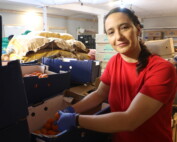

Fred Glass, president and CEO of Gleaners Food Bank of Indiana said today that, with the disastrous SNAP cutoff looming, Gleaners is redoubling its efforts to feed Hoosiers facing hunger as a result of the government shutdown.
“With food insecurity already at its highest rates in a decade,” Glass observed, “this unnecessary SNAP cutoff will likely not only plunge hundreds of thousands of Hoosiers deeper into food insecurity, but abject hunger. Gleaners has built itself into one of the nation’s leading sourcers and distributors of nutritious charitable food, and we are using that expertise to help protect food-insecure Hoosiers during these heretofore unimaginable times.”
For starters, Gleaners is stocking up and staffing up.
Gleaners is dramatically increasing its inventory of nutritious food for people facing hunger by purchasing it from farmers, growers, producers, and other sources. The investments Gleaners has made in its people, facilities, equipment, and sourcing network enable it to buy about nine times what a dollar buys at a grocery store.
This is an unbudgeted cost that Gleaners will meet through a combination of fundraising and other sources. This additional food inventory will be provided to our neighbors facing hunger through food pantries and food banks. It will also be utilized at Gleaners’ on-site pantry to ensure no one is turned away from one of our weekly distributions, which will be expanded during the SNAP cutoff to make them even more accessible to working families.
Gleaners staff is also making sacrifices to help their neighbors in need during this extraordinary time. They are being asked to defer Tuesday’s Veterans’ Day holiday to work on building our food inventory and conduct a food distribution at our on-site pantry.
All distribution and transportation staff, approximately 40 employees, are being asked to significantly extend their work shifts.
In addition, Gleaners is working directly with its more than 300 pantry partners in its 21-county central Indiana service area to identify ways it can help them with the expected surge in food-insecure Hoosiers seeking their help after SNAP funding ends. Similarly, Gleaners has reached out to the 10 other food banks serving Indiana to help provide food for the pantries and the food-insecure Hoosiers they serve.
Gleaners is also working to help the 24,000 Hoosiers who work for the federal government, as well as the 1,100 Hoosiers in the active-duty military, plus the Hoosier farmers and other small businesses who work for the federal government but are not getting paid.
For example, last week, nearly 150 of the 350 employees working for the TSA at the Indianapolis International Airport placed individualized orders for food from Gleaners. Several mentioned they would be able to pay their rent and other bills as a result of receiving food at no cost. Gleaners will have another distribution for TSA employees on November 7th. Gleaners continues to work with other federal agencies impacted by the shutdown, including specifically the Indiana federal courts and the Indiana Army National Guard and its 300 federal employees.
The national administration has now formally advised the state of Indiana that starting on November 5th, they will be stopping Supplemental Nutrition Assistance Program (SNAP) benefits, leaving over 610,000 food-insecure Hoosiers – including 264,000 children and 82,000 senior citizens – without this vital, and until now reliable, lifeline.
Moreover, after pledging less than a month ago that the USDA could use SNAP contingency funds to continue support for the food insecure, the administration declared just last Friday that it would be “illegal” to do so.
The USDA went on to declare that states will not be allowed to cover the cost of SNAP benefits and be reimbursed after the government shutdown ends.
In addition, the administration is not allowing food banks to ask for food they would normally receive from the federal government through The Emergency Food Assistance Program (TEFAP) and similar federal nutrition programs impacting families, especially rural families, who need the nutritious food these programs provide. This decision also negatively impacts the farmers who sell that food to the USDA.
For more than 60 years, without interruption, SNAP has helped people with low incomes buy nutritious food from farmers through local grocery stores.
For 610,000 Hoosiers and millions of Americans, SNAP is all that stands between them and outright hunger and its awful personal and societal costs. Moreover, the natural rise in SNAP participation during tough economic times creates greater SNAP expenditures to naturally and automatically help the overall economy.
Terminating SNAP payments could also lead to the closure of grocery stores, particularly those that tend to be near food deserts. For some independent groceries, SNAP purchases account for most of their sales.
“For every meal the entire charitable food system provides, the federal government has traditionally provided nine, so when the federal government abdicates that role, no one food bank – or even every food bank working together – can come close to meeting the needs of the hungry left behind. Still, Gleaners is working with its employees, volunteers, donors, pantries, and other partners to do everything possible to support our neighbors facing hunger in this perilous moment,” Glass observed.
The need for charitable food is already rising.
In addition to the increased need reflected in the support of TSA and other federal employees, Gleaners’ on-site pantry in Indianapolis this week distributed 50% more food than at the already high levels at which we had been operating.
Once SNAP support is completely discontinued on November 5, even more people will turn to food pantries to try to fill the gap.
“During these uniquely challenging times, Gleaners is working even harder to continue to be a trusted and reliable partner for our neighbors facing hunger and our pantry partners who serve them,” said Glass. “United with others in our community, we will work together to help our neighbors facing hunger get through this uniquely challenging time.”